Payment Impact: Conversion Factor & Specialty Effects
What CMS proposed. For CY2027, CMS estimates two conversion factors (CFs): a qualifying-APM CF of $33.1693 and a nonqualifying-APM CF of $32.8409.1 CMS characterizes these as projected decreases of $0.40 (−1.19%) and $0.56 (−1.68%) from the current (CY2026) conversion factors of $33.4009 and $33.5875, respectively.2 The decrease is not a discretionary CMS reduction: the CY2026 CFs included a temporary +2.50% increase provided by statute for CY2026 only, and CMS removes that increase before applying the budget-neutrality and statutory update factors.3 Each CY2027 CF reflects a +0.53% budget-neutrality adjustment plus the statutory update (+0.75% for QPs, +0.25% otherwise). The Regulatory Impact Analysis (RIA) also publishes estimated impacts on total allowed charges by specialty (Table D-B5).4
Sources: CY2027 PFS proposed rule (CMS-1848-P), Executive Summary and §VII Regulatory Impact Analysis; conversion-factor calculation and Table D-B5.
The two conversion factors
Since 2026, Medicare has two CFs: a higher one for clinicians who qualify for the Advanced APM incentive, and a lower one for everyone else.5
| Conversion factor | CY2027 (proposed) | Projected change from 2026 (per CMS) |
|---|---|---|
| Qualifying APM (QP) | $33.1693 | −$0.40 (−1.19%) |
| Nonqualifying (non-QP) | $32.8409 | −$0.56 (−1.68%) |
Most wound-care practices bill under the non-QP CF unless they participate in an Advanced APM, so the −1.68% figure is the relevant baseline reduction, applied before any specialty-specific RVU effects below.
Estimated impact by specialty
The RIA models how the rule’s RVU and policy changes redistribute payments across specialties. The figures below are the total combined impact (Column G)6 for the specialties most relevant to wound care. These are estimated CY2027 changes relative to CY2026, a single-year, year-over-year comparison, not cumulative changes across multiple years. Per the rule’s own footnote, they exclude the statutory CF updates above; those are additional.7
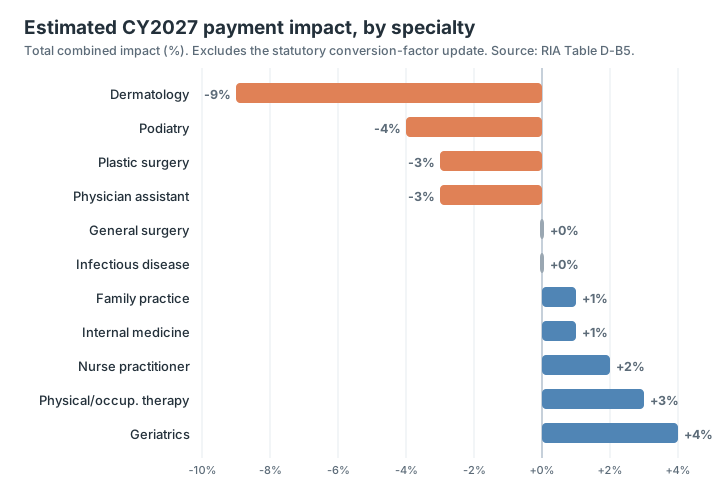
CMS attributes the dermatology, podiatry, and plastic-surgery declines chiefly to the modifier -25 payment reduction and the removal of indirect practice-cost inputs (IPCI) from PE RVUs.8 The largest negative impacts across all specialties fall on otolaryngology, dermatology, and podiatry.9
Why it matters for wound care
Wound-care practices don’t bill under a “wound care” specialty code; their Medicare payments flow through whatever specialty their clinicians enrolled under. That makes the specialty distribution above an approximate map of which settings gain and which lose:
- Office and wound-center practices billing under dermatology, podiatry, or plastic surgery face −3% to −9% before the −1.68% CF decrease is layered on.
- Practices staffed by nurse practitioners and PAs in facility settings, and those billing geriatrics / family practice, are among the few with positive facility impacts, reflecting the SNF E/M equalization.
Deep-dive: implications by practice model
Office-based wound care billing under dermatology/podiatry/plastic surgery absorbs both the specialty-level cut (−3% to −9%) and the −1.68% CF reduction. The combined effect is compounding, and it varies with each practice’s code mix; the headline specialty average does not apply evenly across practices.
The combined effect depends on a practice’s specific code mix under the proposed RVUs and CF; the specialty average understates the impact where revenue concentrates in the affected code families. The share of revenue from same-day E/M-plus-procedure claims (the modifier -25 exposure) is a key driver of that variation.
Mobile and traveling providers deliver wound care wherever the patient lives, from private homes to skilled nursing facilities. Both settings sit largely outside the specialty cuts that weigh on procedure-heavy offices, but they diverge on which E/M rules apply.
Mobile providers billing home-or-residence E/M (99341–99350) are largely insulated from the specialty cuts that hit procedure-heavy office practices, and can carry the new MOD1 complexity modifier on those visits.
The positive facility-setting figures (NP +6%, geriatrics +7%) fall largely within the mobile/SNF model. For practices with a mix of office and mobile service lines, the CY2027 proposal shifts the relative economics further toward mobile.
SNF-based rounding practices benefit from the nursing-facility E/M equalization, reflected in the positive facility figures for NP, geriatrics, and family practice, one of the few positive impacts in this rule.
The SNF model shows the clearest relative gains in this rule. For SNF-based practices, the restored POS 31 payment applies to the visit volume that the CY2026 change had cut.
Hospital-outpatient wound centers bill facility rates; the RIA facility columns generally show smaller swings than non-facility. But provider-based professional fees still follow the specialty distribution, and the CF reduction applies.
Facility (technical) and professional-fee exposure diverge here: the professional component tracks the specialty impacts above, while the facility component is governed by OPPS, not this rule.
Considerations for providers and manufacturers
Each point below states what CMS proposed and then what it would mean in practice. These are analytical implications, not recommendations; some stakeholders may also weigh them when deciding whether to submit input during the public comment period.
The total reduction is a stack the headline number doesn’t show. The −1.68% conversion-factor decrease lands on top of specialty-level RVU changes (dermatology −9%, podiatry −4%), and those specialty figures already exclude the CF update. A dermatology-billing wound office could therefore see roughly −9% from specialty effects, then −1.68% on top, then a further reduction on its same-day E/M volume from modifier -25. No single specialty-average number captures that combination, so modeling the practice’s own code mix is the only way to see the true figure, and the average will generally understate it for procedure-heavy wound practices.
A standing 2% sequestration sits underneath all of these figures. Separately from this rule, the Budget Control Act’s 2% Medicare sequestration continues to reduce every fee-for-service payment at the claim level, applied after the fee schedule. Because it applies in both CY2026 and CY2027, it does not add to the year-over-year change above; it is a constant reduction in the actual dollars a practice receives that the RVU, CF, and RIA figures on this page do not reflect.10
The specialty table can obscure the office-vs-facility split that is central to this rule’s effects. The RIA reports impact by enrollment specialty, not by care setting, yet this rule’s effects diverge sharply by setting: office and wound-center down, mobile and SNF comparatively up. Because wound care spans many specialty codes, no single table row describes “wound care,” and a stakeholder reading only the specialty view may misjudge their exposure. The setting-level view that actually maps to how wound care is delivered is one CMS could be asked to produce.
The public comment period is open through September 14, 2026 (docket CMS-2026-2377). See How to Comment for the mechanics.
Footnotes
Proposed rule §VII (Regulatory Impact Analysis), conversion-factor calculation, §VII.D.1 (CMS-1848-P, 91 FR 44241). CMS states:
“We estimate the CY 2027 PFS qualifying APM CF to be 33.1693 which reflects a 0.53 percent positive budget neutrality adjustment required under section 1848(c)(2)(B)(ii)(II) of the Act and the 0.75 percent update adjustment factor specified under section 1848(d)(20) of the Act. We estimate the CY 2027 PFS nonqualifying APM CF to be 32.8409 which reflects a 0.53 percent positive budget neutrality adjustment required under section 1848(c)(2)(B)(ii)(II) of the Act and the 0.25 percent update adjustment factor specified under section 1848(d)(20) of the Act.”↩︎Proposed rule §I.C (Summary of Costs and Benefits), Executive Summary (CMS-1848-P, 91 FR 43844). CMS states:
“Under these provisions, the 2027 qualifying APM conversion factor represents a projected decrease of $0.40 (-1.19 percent) from the current conversion factor of $33.4009. Similarly, the 2027 nonqualifying APM conversion factor represents a projected decrease of $0.56 (−1.68 percent) from the current conversion factor of $33.5875.”↩︎Proposed rule §VII (Regulatory Impact Analysis), conversion-factor calculation, §VII.D.1 (CMS-1848-P, 91 FR 44241). CMS states:
“To calculate the estimated CY 2027 PFS conversion factors, we took the CY 2026 conversion factors without the payment increase of 2.50 percent provided by statute that applied to services furnished from January 1, 2026 through December 31, 2026 and multiplied them by the budget neutrality adjustment required as described in the preceding paragraphs, then multiplied by the qualifying APM and nonqualifying APM updates specified by section 1848(d)(20) of the Act.”↩︎Proposed rule §VII (Regulatory Impact Analysis), Table D-B5 introduction, §VII.D.1 (CMS-1848-P, 91 FR 44242). CMS states:
“Table D-B5 shows the impact on PFS payment for physicians’ services based on the proposed policies included in this rule. To the extent that there are year-to-year changes in the volume and mix of services provided by practitioners, the actual impact on total Medicare revenues will be different from those shown in Table D-B5 (CY 2027 PFS Estimated Impact on Total Allowed Charges by Specialty).”↩︎Proposed rule §VII (Regulatory Impact Analysis), conversion-factor calculation, §VII.D.1 (CMS-1848-P, 91 FR 44241). CMS states:
“As required by section 1848(d)(1)(A) of the Act, beginning in CY 2026, there are two separate conversion factors (CFs): one for items and services furnished by a qualifying APM participant as defined in section 1833(z)(2) of the Act (referred to as the qualifying APM conversion factor) and another for other items and services (referred to as the nonqualifying APM conversion factor), equal to the respective conversion factor for the previous year multiplied by the update established under section 1848(d)(20) of the Act for such respective conversion factor for such year. As specified by section 1848(d)(20) of the Act, the update to the qualifying APM conversion factor for CY 2027 is 0.75 percent while the update to the nonqualifying APM conversion factor for CY 2027 is 0.25 percent.”↩︎Proposed rule §VII (Regulatory Impact Analysis), Table D-B5 column explanation, §VII.D.1 (CMS-1848-P, 91 FR 44243). CMS states:
“Column G (Combined Impact): This column shows the estimated CY 2027 combined impact on total allowed charges of all the changes in the previous columns. Column G may not equal the sum of columns D, E, and F due to rounding.”↩︎Proposed rule §VII (Regulatory Impact Analysis), Table D-B5 scope note, §VII.D.2.a (CMS-1848-P, 91 FR 44249). CMS states:
“The 0.75 percent and 0.25 percent updates to the CY 2027 and nonqualifying APM conversion factors, respectively, are statutory changes that take place outside of BN, and therefore, are not captured in the specialty impacts displayed in Table D-B5.”↩︎Proposed rule §VII (Regulatory Impact Analysis), CY 2027 PFS impact discussion, §VII.D.2.a (CMS-1848-P, 91 FR 44248). CMS states:
“Specialties that would see a significant decrease include dermatology, otolaryngology, orthopedic surgery, and hand surgery, and to a smaller extent, ophthalmology, podiatry, audiologists, neurosurgery, portable x-ray suppliers, and plastic surgeons. These changes can largely be attributed to the proposed changes to modifier -25 and the proposal to remove the Indirect Practice Cost Index (IPCI) from the calculation of the PE RVUs, although the effects on PE are mitigated by the proposed PE stabilization adjustment.”↩︎Proposed rule §VII (Regulatory Impact Analysis), CY 2027 PFS impact discussion, §VII.D.2.a (CMS-1848-P, 91 FR 44248). CMS states:
“The proposal to reduce payment when a separately identifiable office/outpatient E/M visit is furnished by the same physician (or a physician in the same group practice) on the same day as a 0-, 10-, or 90-day global procedure and identified on the claim with modifier -25 would have the largest negative impact on otolaryngology, dermatology, and podiatry, and to a smaller extent, hand surgery, physicians assistant, and colon and rectal surgery. These specialties frequently report E/M services with modifier -25 in conjunction with a 0-, 10-, or 90-day global procedure.”↩︎The 2% Medicare sequestration originates in the Budget Control Act of 2011 (Pub. L. 112-25) and applies to Medicare fee-for-service claims dated on or after April 1, 2013, reducing the Medicare payment by 2% after the deductible and coinsurance are applied. It is not part of the CY2027 PFS rule. The Consolidated Appropriations Act, 2026 (Pub. L. 119-75) extended the Medicare mandatory sequester (2%) into the early 2030s.↩︎